Sunday, June 14, 2020

Source and Summit


This the truth each Christian learns,
Bread into his flesh he turns,
To his precious blood the wine:

Sight has fail’d, nor thought conceives,
But a dauntless faith believes,
Resting on a pow’r divine.

—From the sequence Lauda Sion, given during the Mass of Corpus Christi

As Catholics, we would do well to reflect on the Eucharist which the Catechism of the Catholic Church calls “the source and summit of the Christian life” (from paragraph 1324, and sourced to Lumen Gentium 11 which says that the Eucharistic sacrifice “is the fount and apex of the whole Christian life”).

In the Gospel of John, when Jesus claims, “I am the living bread that came down from heaven; whoever eats this bread will live forever; and the bread that I will give is my flesh for the life of the world,” the Jews quarreled among themselves and asked “How can this man give us his flesh to eat?” These Jews did not have faith in Jesus Christ. They did not trust God’s Word. A little bit later in the Gospel, Jesus turns to other Jews, who are also his disciples, and he asks them if they also wished to leave him. Simon Peter replies, “Master, to whom shall we go? You have the words of eternal life. We have come to believe and are convinced that you are the Holy One of God” (see John 6:51-69). Peter, our spiritual father in the Christian faith, does have faith in the Christ.

Was Peter’s faith perfect? Far from it. He later denied Christ during his Passion. Peter is part of that long line of sinners since Adam and Eve. Imperfect though he was, he followed Christ as a Christian to the end of the race, his trial here on earth. So does our faith rest on Peter? Not entirely. Although Peter is the Rock upon which Christ builds his Church (cf. Matthew 16:18), Peter’s faith depends very much on Christ. Peter was the fertile soil in which the Holy Spirit planted faith. The gift of faith just as the gift of life and the gift of eternal life is not our own, but grace from God. We need to be receptive to that grace.

It is a mystery why the Father chose to express his love for us by having his Son take on our frail humanity. Why should He transmit this grace through human Body and Blood? And while this particular human body and blood is also Divine, God continues in this mode of transmitting the faith though human body and blood.

Our senses cannot perceive that Jesus is actually and truly present in the Eucharist. The accidents remain. Putting aside Eucharistic miracles, there is no test using the modern scientific method that reveal anything other than bread and wine. And so this is the apex of the faith, for if one cannot trust the Church (insofar as she is guided by the Holy Spirit) and if one cannot trust Jesus himself, then it seems natural to be skeptical about Jesus being actually and truly present in what appears to be bread and wine. One only has God’s Word on this.

And so regarding the Eucharist sacrifice—called "the breaking of the bread" in Acts of the Apostles—as the source, it seems to me that I would not be a Christian but for the Catholic Church. From the beginning, Christians in an unbroken chain witnessed to their faith, and many times their witness extended to the point of giving up their lives as martyrs. Without that faith, the belief that Christ, the Son of God incarnate, was crucified, died and rose again on the third day, everything would be undone. It’s not because any mere human being merits that trust. The Christian faith would be a failure if it were not for God. That is, with God, nothing is impossible; but without God nothing is possible. What I mean to say is that I trust the Father who gave us his Son, and I trust the Son who gave us his all in all, and I trust in the Holy Spirit whom the Father and the Son sent to guide His Church. The failure to give us eternal life would be the the failure to give us eternal life.

“Whoever eats my flesh and drinks my blood has eternal life, and I will raise him on the last day” (John 6:54).

Tuesday, February 4, 2020

Illustrating Theology: Grace and Mercy

The Bible often uses light for God and his grace. Indeed the Nicene Creed states, "God from God, Light from Light, true God from true God." But for today, it seemed to me that rain and umbrellas would work to illustrate grace and mercy.

God rains down his grace and mercy, but in our free will we can reject it. We can put up an umbrella to shield us from the rain.
Image by _Alicja_ from Pixabay
But on the other hand we can take great joy in the water pouring down.
Image by Fifaliana Joy from Pixabay
And this also illustrates something about creation and God. These days, it seems that we view rain pouring down in a negative way. But these negative things which come our way can turn out to be for our greater good.
Rejoice always,
pray constantly,
give thanks in all circumstances;
for this is the will of God in Christ Jesus for you.

(1 Thes 5:16-18)


Participation

One possible reason people why people find belief in God unreasonable is related to their understanding of the nature of God.
Deist understanding of God
Deists accept God as creator of creation. God is transcendent but unconcerned and uninvolved in his creation. A common analogy is of God as a watchmaker. God creates and sets creation in motion (as one would wind up a watch -- if anyone still winds a watch these days -- or winds up a toy), but the existence of creation is now independent of God. That is, in the universe of all being, God, creation, and all creature stand side by side. I think this understanding of God is ultimately untenable, and makes belief in the Trinitarian Son of God becoming incarnate very difficult. How would God enter into and move within his creation? The huge problem with this understanding of God is that it puts limits on God who is infinite.

St. Thomas Aquinas argued that the essence of God is existence. That is the nature of God is existence itself or that there is no division between God's nature and his existence. In Aristotelian terms God is pure act, lacking any potential. God simply Is.
A Trinitarian Theistic understanding of God and creation
In the figure above, creation is not apart from God. God is both transcendent and immanent. Of course there are problems with graphical representations of God (indeed, trying to express the nature of an infinite God with limited human words and concepts is fraught with difficulties). Putting the green dot representing creation within God might lead someone to think that I'm saying that creation is a part of God. Creation is distinct from God, not part of God, but participating or sharing God's to-be or being. (Additionally, the graphical representation of the Trinity might lead someone to think that each person, Father, Son, and Holy Spirit are pieces of the whole God. Rather the Father is God, the Son is God, and the Holy Spirit is God. The shield of the Trinity is a better, but still limited, way of representing the Trinity)

I did a presentation trying to explain this participation for my local Bible study group. Here are the notes with graphical slides of that talk.

Thursday, June 28, 2018

I Have Not Suffered as I Should

Drawing of the crucifixion by St. John of the Cross (Public Domain)
"I do not promise to make you happy in this life, but in the next."
-- Our Lady of Lourdes to Saint Bernadette Soubirous

I have not suffered as I should. I have been lucky or unlucky, depending on perspective. I've been lucky enough to have tasted love. Enough to know that I would promise to suffer anything for that love. Of course, I know I am not as reliable as all that. I am fortunate that I've not been tested to my breaking point. And I know that I should be preparing for that test, that measure of love (cf. Jn 21:15-19).

I have not suffered as I should, because someone suffered for me. On the Cross, he cried out the mystery of suffering, "My God, my God, why have you abandoned me?" Part of the resolution of this mystery (again, only a partial resolution) is knowing those words begin Psalm 22. The Psalms are the good, the bad, and the ugly of human experience. From the imprecatory "Blessed the one who seizes your children and smashes them against the rock" (Ps 137:9) to the comforting "Even though I walk through the valley of the shadow of death, I will fear no evil, for you are with me; your rod and your staff comfort me" (Ps 23:4). And the Word of God became incarnate, He became human; "And the Word became flesh and dwelt among us" (Jn 1:14). And in His human nature, the incarnate God knew suffering.

The crazy part about this is that this Jesus tells us crazy things like "If any man would come after me, let him deny himself and take up his cross daily and follow me" (Lk 9:23, see also Mt 16:24 and Mk 8:34). And His Apostle says, "pray constantly, give thanks in all circumstances; for this is the will of God in Christ Jesus for you" (1 Thes 5:17-18). I remember the apostle's words particularly because soon after praising the words as wisdom, I was tested. I wasn't greatly tested, but I was tested enough to remind me that I should take them seriously, and truly take these words to heart. Indeed, God seems to have that twisted sense of humor such that St. Teresa of Avila complained, "If this is how You treat Your friends, no wonder why You have so few of them!" St. John of the Cross of the dark night of the soul fame was a friend of St. Teresa.

But I have not suffered as I should, so I cannot wholly know the sufferings of those who have deeply suffered. I see some clutch desperately to their faith, and others whose sufferings test their faith beyond imagining. I am helpless. But I will pray for them. If I can, I'll walk with them. And listen.

Life as Suffering

We modern Catholics in America are not well prepared for suffering. Bourgeois Catholics are used to material well-being, and pain and suffering are unfamiliar. We don't know how to deal with suffering within ourselves or in others.

So while this post is in response to Leticia Adams' Inadaquecy, Changes and Life and Elizabeth Scalia's When There Are No Human Answers to Our Measures of Pain, and in response to observations of friends in their struggles with faith due to suffering, and although I lack the requisite wisdom to help those who are deeply wounded and surrounded in darkness, I will dare to suggest how we might prepare for suffering.

Pray: there is no way we can help without Christ. Find your own Calcutta: copy Mother Teresa by finding a ministry or situation to help others. Mortification: more than just for disciplining ourselves, consider penance for ourselves and others.

Suggested reading: Peter Kreeft's Three Philosophies of Life where I borrowed the subtitle Life as Suffering. C.S. Lewis' The Problem of Pain and A Grief Observed. Saint John Paul II, Salvifici Doloris.
Suggested devotion: consecration to Jesus through Mary. I find St. Louis de Montfort's method and 33 Days to Morning Glory compliment each other.

Final suggestion: be humble. My contribution is a Socratic I don't know a whole lot.

Monday, May 21, 2018

The Church: Mother, Filled with the Holy Spirit

Mosaic of Mater Ecclesiae in St. Peter's Square (Public Domain)
Yesterday was Pentecost, sometimes called the birthday of the Church, when the Holy Spirit descended upon the disciples as tongues of fire. Traditionally, that place where this happened is known as the Upper Room, the same place as that of the Last Supper. The disciples are transformed. Unlike their behavior during the passion of Christ before his Crucifixion, when almost all of them fled, they are now boldly proclaiming Christ crucified and his Resurrection.

As St. Paul states in 1 Corinthians 15:14, "if Christ has not been raised, then our preaching is in vain and your faith is in vain." The Resurrection is crucial to the Christian faith. We believe the Apostles because they are credible witnesses of the Resurrection of Jesus Christ. They claim they actually saw the risen Jesus after he was crucified and died. And except for John, all the Apostles were martyred for their faith. The word "martyr" comes from the Greek for witness. Their deaths make them credible witnesses to their claim of actually seeing the risen Christ. Lutheran Satire has a good video on what if the Apostles made it all up.

But it's more than this. Not only does the Holy Spirit give the Apostles the supernatural assistance which helps the courage of the Apostles in the face of death, the Holy Spirit is the Spirit of Truth. The Church herself is guided by the Holy Spirit. And so St. Paul can say in 1 Timothy 3:15 that the Church is "the pillar and bulwark of the Truth." And that makes sense, since we know better (at least we hope so) than to trust in fallen human beings. And Scripture does record some of the foolish things the thick-headed disciples did. We are all works in progress. Interestingly, after Napoleon Bonaparte threatened to destroy the Catholic Church, Cardinal Ercole Consalvi is reported to have replied, "If in 1,800 years we clergy have failed to destroy the Church, do you really think that you'll be able to do it?" God is the key ingredient of His Church.

After the Resurrection, Jesus, who has been given all authority in heaven and on earth, commissioned his Apostles to spread the Gospel, the Good News (Mt 28:18-20). The Church has the authority to teach in His name on matters of faith and morals. This teaching authority is called the Magsterium. The Church does not create this deposit of faith, but rather defends and develops it (this development is a deepened understanding of the Truth handed down to her).

Today's Gospel reading for the feast of Mary, Mother of the Church is taken from John 19:25-34. In beginning of this reading, Jesus is on the Cross, and gives his mother to his disciple John, and gives John to his mother. Like many passages in Scripture, there are multiple layers of meaning. The first truth is that John did take care of Mary as his mother from that moment on. But the Church also understands that John symbolically points to the whole Church. As through Christ, we all become adopted sons and daughters of the Father, so also through Christ, we become adopted sons and daughters of Mary. Mary is our mother; she is the mother of the Church. This is the human aspect of the Church. For as through Mary, the Word became flesh, so also, the body of Christ, the Church is made up of human members, the living stones of the Church.

There are many parallels between Mary and the Church, and a rich tradition of Church Fathers who called Jesus the new Adam, and Mary the new Eve, but I wish to keep this simple. Perhaps I will take up these sorts of amazing connections in future.

St. Paul makes several references about the Bride of Christ as the Church (such as in Ephesians 5). That strongly hints of the unity of Christ the head with the Church his body. But Acts 9 expresses this unity in a way which leaves no doubt. Paul, when he was still called Saul, was persecuting the Church, murdering her members. On the way to Damascus, Saul sees a blinding flash, and Jesus asks, "Why are you persecuting me?" The Church is Jesus Christ.

My reason for stressing this unity between Christ the head and his Church is because the Church is both mother and teacher. The denial of her authority in matters of faith and morals is widespread. But only by the authority of the Church guided by God the Holy Spirit do I find the witness of the Resurrection plausible. It is not by the personal holiness of her members, for I find them to be in desperate need of Jesus Christ. The Catholic Church is indeed a field hospital for sinners. And yet the Church thrives, despite the foolishness and sinfulness of her leaders and laity. Some of them are known to be cured -- those who we definitely know are saints in heaven -- and we can point to them as evidence of the Holy Spirit at work in the world. And we ordinary folks hope that we too will be cured, and restored to the health we were meant to have, filled with the Holy Spirit.

Friday, April 14, 2017

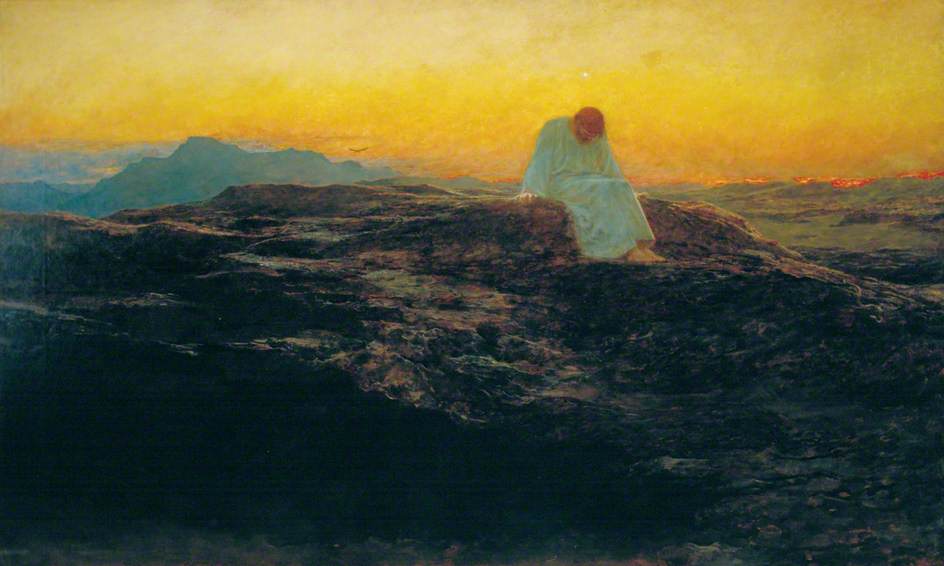
Time in the Desert

The Temptation in the Wilderness by Briton Rivière
On the Tuesday before Ash Wednesday, I told my kids in religious education (commonly called CCD) about the Church's rules for fasting and abstinence. And I told them about my Lenten plans regarding food which were stricter than the Church requires. Since the children were under the age where the fasting rules applied, this was unfamiliar to them. To them, fasting seemed to be a terrible burden. After class, I spoke to another adult. We shared similar experiences regarding our plans for Lent. We both had difficulty in restraining ourselves outside of Lent. But for Lent anything seemed possible. And I had ambitious plans.

Almsgiving, prayer and fasting are the traditional focus for Lent. Lent is a spiritual bootcamp that mirrors Jesus' time of 40 days in the desert. This mortification makes no sense in itself, but rather its goal is a preparation for Easter, and growing closer in your relationship with God. It's about love.

People grasp the concept when it comes to romantic love. In (Everything I Do) I Do It for You, Bryan Adams sings of the depths of his love:
Look into your heart,
You will find
There's nothin' there to hide
Take me as I am,
Take my life
I would give it all, I would sacrifice
That sacrifice for love has a theological name, kenosis. It's beautifully expressed in Philippians 2:5-8:
Have among yourselves the same attitude that is also yours in Christ Jesus,
Who, though he was in the form of God,
    did not regard equality with God something to be grasped.
    Rather, he emptied himself,
    taking the form of a slave,
    coming in human likeness;
    and found human in appearance,
    he humbled himself,
        becoming obedient to death,
        even death on a cross.
But for us fallen human beings, there are traps and temptations along the way. We can become too focused on the externals. We can become too focused on the sacrifice and the giving of alms and prayer. We can think that perhaps we have earned God's love and entry into heaven.

There is nothing we can do to earn God's love. The good news is that God's love for us is already present. Before we came to be, God loved us. Thomas a Kempis moves into this paradox of our unworthiness and God's unremitting  love for us:
   Trusting in Your goodness and great mercy, O Lord, I come as one sick to the Healer, as one hungry and thirsty to the Fountain of life, as one in need to the King of heaven, a servant to his Lord, a creature to his Creator, a soul in desolation to my gentle Comforter.
    But whence is this to me, that You should come to me? Who am I that You should offer Yourself to me? How dares the sinner to appear in Your presence, and You, how do You condescend to come to the sinner? You know Your servant, and You know that he has nothing good in him that You should grant him this.
    I confess, therefore, my unworthiness. I acknowledge Your goodness. I praise Your mercy, and give thanks for Your immense love.
And Scripture is clear, it is not the sacrifice that God wants:
For you take no delight in sacrifice;
    were I to give a burnt offering, you would not be pleased.
The sacrifice acceptable to God is a broken spirit;
    a broken and contrite heart, O God, you wilt not despise.
(Psalm 51:16-17)
And so this is the real movement, the interior movement of the heart. Many people reduce Christianity to an ethical philosophy or a moral rulebook. But that misses the heart of Christianity, a lived relationship with God Almighty.

And so how did I do? How did my plan for Lent go? Some parts went according to plan and some didn't. Perhaps I moved an inch closer to God. or perhaps a millimeter. More importantly, it was a turn toward God; I was able to examine my heart with greater clarity, for by God's grace, a light was shone on it. I chastised my heart.

For what does God want, if He "take[s] no delight in sacrifice"? Last night, on Holy Thursday, I went to church with The Imitation of Christ by Thomas a Kempis. I stayed afterwards an hour with Jesus in the Blessed Sacrament. And I opened the book, and prompted by grace, I turned the pages to the following:
Christ:
   As I willingly offered Myself to God My Father, for thy sins, with My hands stretched out upon the cross, and My body naked, so that nothing remained in Me which was not turned into a sacrifice to appease the divine wrath:
   Even so must thou willingly offer thyself to Me daily in the Mass, for a pure and holy oblation, together with all thy powers and affections, as intimately as thou art able.
   What do I require more of thee, than that thou endeavor to resign thyself entirely to Me?
   Whatsoever thou givest besides thyself I regard not; for I seek not thy gift, but thyself.